

First Steps following a Bereavement
When somebody dies, it is of course a very individual and personal experience, however in every case there are some similar tasks that have to be performed, and this page is designed to point you in the right direction.
Most importantly you should remember that as professional funeral directors we are here to guide you through the whole process. For any questions not covered by this page, a simple telephone call to our office will usually give you the answer.
When an Expected Death Occurs:
At Home
If the deceased is at home, in the first instance, you will need to contact the registered GP of the person so the death can be formally verified. If the death occurs outside of normal surgery hours, you will need to call 111 or if the deceased was under the care of the local District Nurse Team, you can contact them directly. Once this has taken place, you will be given authorisation to contact us to make arrangements to bring the person into our care.
Hospice or Residential/Nursing Home
If the deceased is in a hospice or residential/nursing home, the staff on duty will be responsible for contacting either the GP, 111 or District Nurse Team, or they may have a member of staff who is able to complete the formal verification. They will either advise that you need to contact us to make arrangements to collect the deceased or more usually they would contact us on your behalf.
Hospital
If the person dies in hospital, we will not be able to attend to collect the person until we have received the authorisation to do so from the Bereavement Team.
In the first instance, you will need to call the Bereavement Team to advise them that we are your nominated funeral director. The Bereavement Team will then inform us when the deceased is ready for collection.
Obtaining a Death Certificate
In all of the above circumstances, the death of the person will be referred to the Medical Examiner’s Office. When the death has occurred outside of a hospital setting, the usual GP Practice will make a formal referral to the Medical Examiner’s Office. In cases where the death has occurred in hospital, this will be managed by the Bereavement Team.
The Medical Examiner’s Office
The role of the Medical Examiner is to review all deaths that occur in England and Wales (that fall outside the remit of His Majesty’s Coroners).
Once they have received the referral, it will be reviewed, and you will then be notified by the Medical Examiner’s Office that an appointment the register the death can be made. Please note that an appointment should be made within 5 days.
Registering the Death
When someone dies the death must be registered by the Registrar of Births, Marriages and Deaths. Usually this will take place in the county that the death occurred. You can register in another county by a process known as ‘Registering a Death by Declaration’.
You will be required to make an appointment before you visit either online or by telephone.
At the appointment, you will need to purchase Certified Copies of the Death Certificate. This is used to administer the deceased’s estate, for closing bank accounts and other private affairs. You will need to consider how many copies you will need prior to this appointment.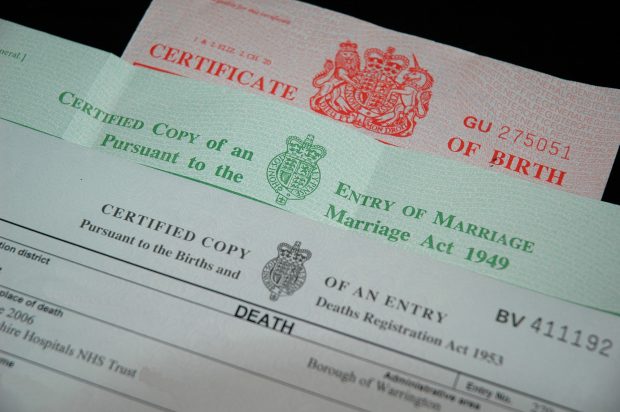
The following information is needed by the registrar:
- The full name and surname of the deceased (and the previous name if the deceased was married)
- The deceased’s usual address.
- The deceased’s date and place of birth.
- The deceased’s date and place of death.
- The deceased’s occupation.
- If the deceased was married, the date of birth of the surviving widow or widower.
- The informant’s (person visiting the register office) name, address and qualification.
- Location of burial or cremation
- Funeral Director information
Tell Us Once
The Registrar will offer you the opportunity to use the government service known as ‘Tell Us Once’. This service will allow you to notify central and local government services when someone dies. This service is free, easy to use and reduces unnecessary phone calls.
When an unexpected death occurs:
In these circumstances, the death will be reported to His Majesty’s Coroner for further investigation. Generally, the Coroner becomes involved with deaths which are sudden, unexpected, due to accidents or of unknown cause. The Coroner’s role is to establish the exact cause of death. The Coroner’s involvement is by no means unusual and you should not be worried if this is the case. It does mean however, that the registration procedure may be altered but if you speak to us we can advise you what to do.
If an unexpected death occurs either at home or in the community, in the first instance you must dial 999. Sometimes the paramedics will be in attendance but for every case, the police will attend.
We will not be able to collect the deceased at this point. The Coroner’s Officers will make arrangements for the deceased to be collected by their representative and taken into their care. We will make arrangements to collect the deceased once authority has been granted.
If an unexpected death occurs in hospital, the deceased will remain in the care of the hospital until the Coroner grants permission for us to collect the deceased.
Arranging the Funeral
As already mentioned, each and every funeral is distinct from any other and making it appropriate for the person and family concerned is our main priority. Ideally the arrangements and service should reflect the wishes of both the deceased and those left behind and if this is not possible a balance should be struck. In years past the majority of funerals in this country would have been based around the rites of the Church of England, however, today there are a number of different options that can be arranged.
Some decisions about the funeral need to be made earlier than others. One which should be made at an early stage because it influences a number of the other details is whether the funeral will conclude with burial or cremation. Once that decision has been made it is our aim to arrange the funeral to take place at a time and date which is convenient for you. However, it is important to remember that many factors affect when a funeral can take place, including when the death certificate is available, whether or not the Coroner is involved and the availability of the celebrant/minister and the cemetery or crematorium.
It is usual to expect the funeral to be about 10-14 days from the date of death however there is of course a degree of flexibility and we will endeavour to accommodate your wishes. There are many options as to where the funeral can be held, including but not limited to, your local church or chapel, local crematoria and woodland burial grounds. Detailed below we have outlined some of the things you may like to consider before we meet to discuss the funeral in detail.
- Will the service conclude with burial or cremation?
- On the day of the service where will the hearse leave from and will you require any limousines?
- Do you want any particular vehicles, perhaps a horse drawn or motorcycle hearse?
- Will the service be religious or secular?
- Do any family members or friends wish to be involved with the service in some way?
- Is there any particular, music, readings or hymns you would like included in the service?
- Do you want any newspaper announcements to be placed for you, if so in which newspaper/s?
- Do you wish mourners to send floral tributes or charitable donations in lieu?
- Will anyone wish to visit the deceased in our Chapel of Rest or indeed will you want the deceased brought to rest at home?
- Would you like the deceased to be dressed in their own clothing or in a gown that we can supply?
- What sort of coffin would you like for the funeral?